
MEP Shop Drawing Services Precision Technical Drawings for Construction and Fabrication
Accurate mechanical, electrical, and plumbing (MEP) shop drawings mapping out exact dimensions, materials, and detailed installation guidelines. Bridge the gap between engineering concepts and physical field installation.
Why MEP Shop Drawings Are Essential
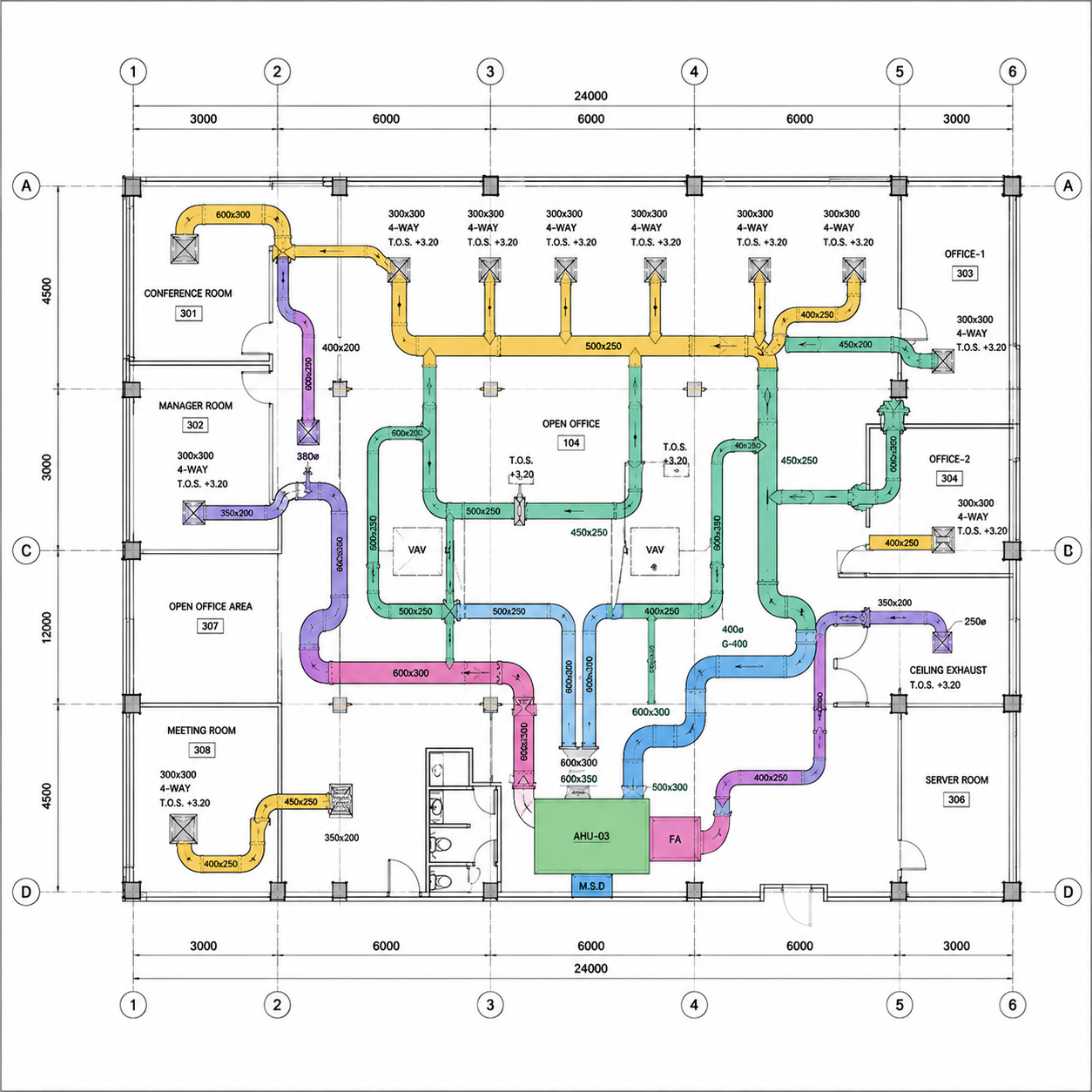
Modern construction is a very complicated process, in which the difference between a successful outcome and costly failures often lies in the presence of accurate MEP shop drawings. The technical documentation plays an essential role in providing an overview of mechanical, electrical, and plumbing systems.
MEP shop drawings represent scaled drawings of a building's mechanical, electrical, and plumbing systems that contain exact dimensions, materials, and detailed installation information. Unlike the design drawings, which show only the idea behind the building construction and the general scheme of how it would look after completion, MEP shop drawings are designed specifically for contractors and subcontractors, who need detailed information about construction processes, equipment, and manufacturing/installation sequences.
How Are MEP Shop Drawings Created?
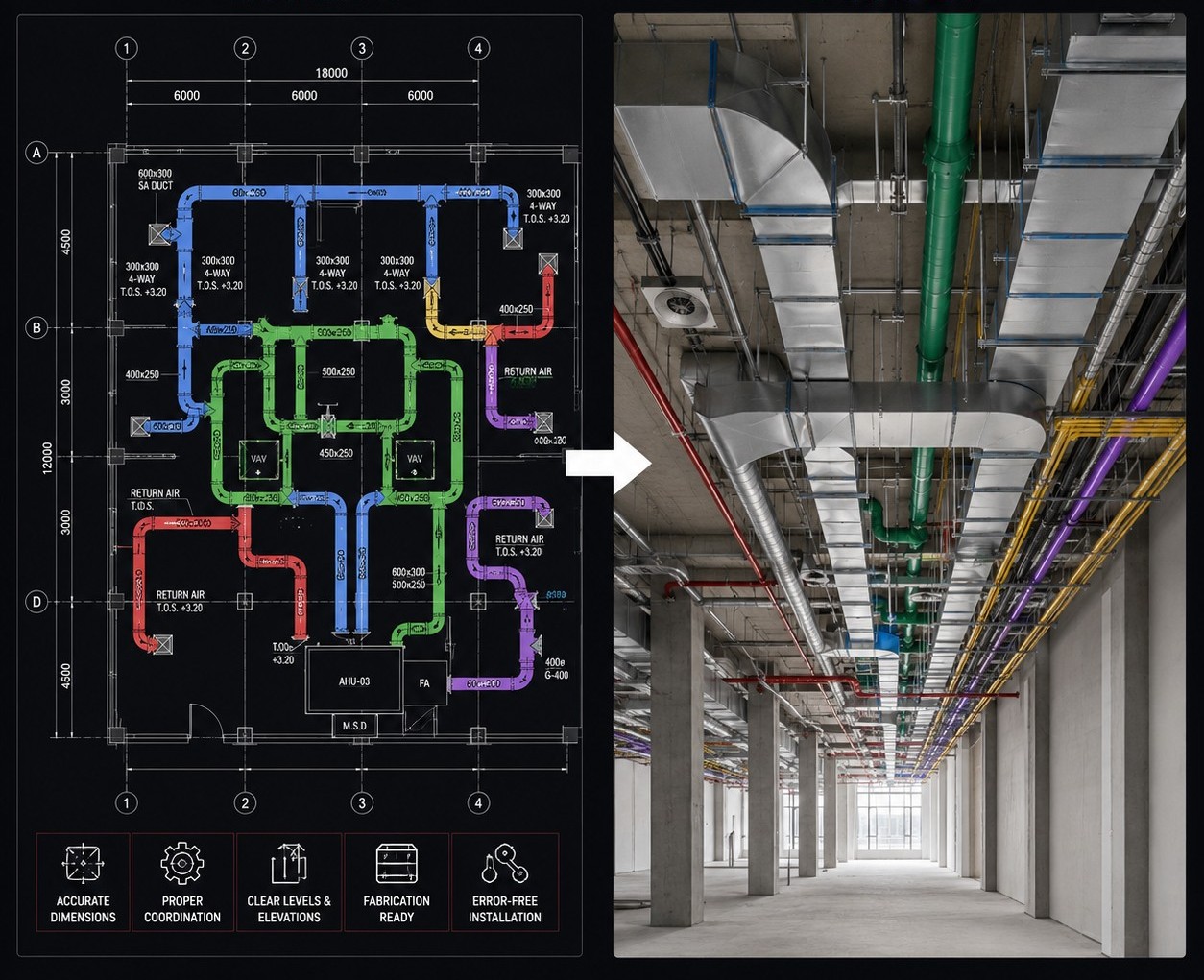
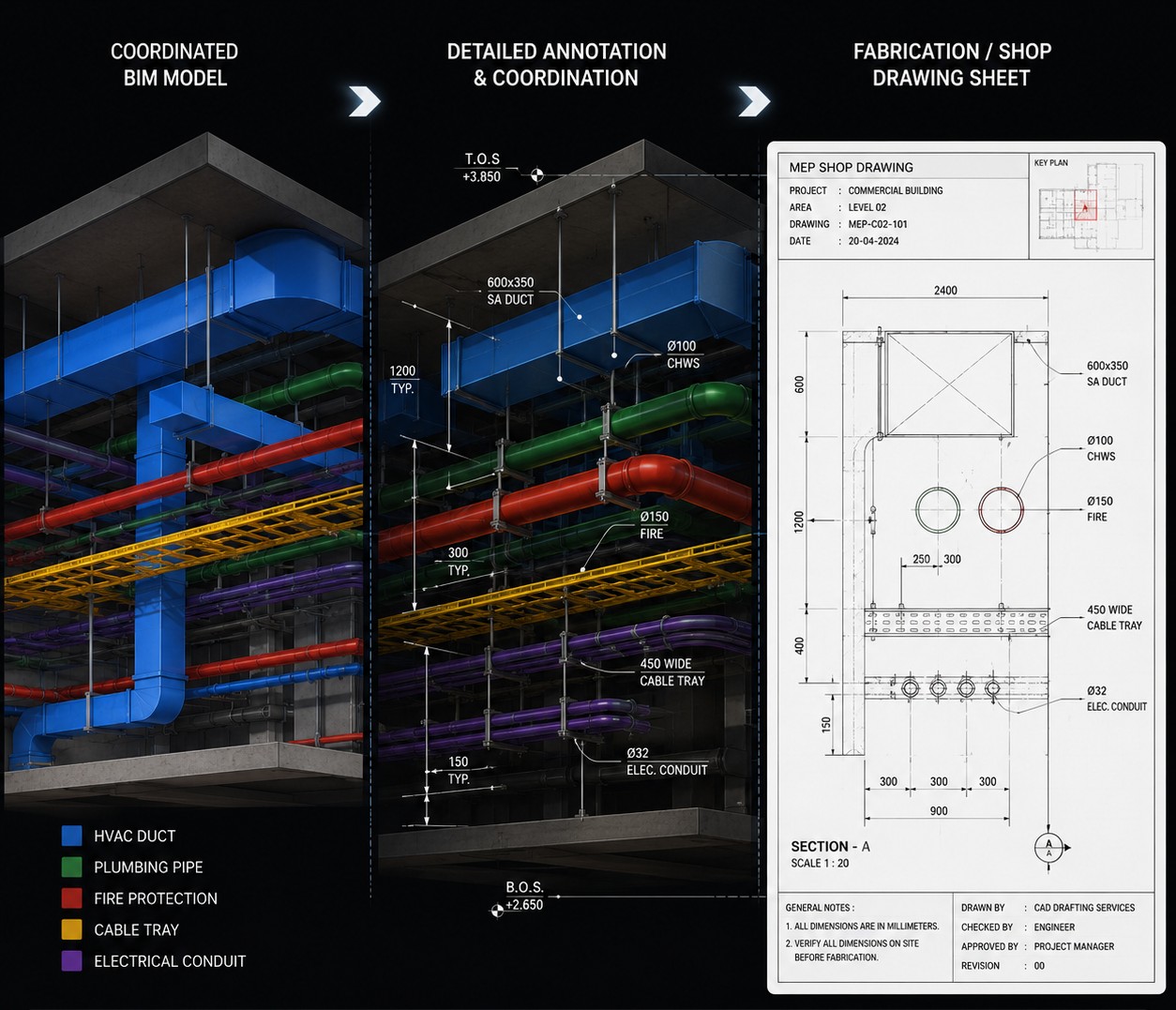
MEP shop drawings are created based directly on detailed MEP models and 3D models. These documents represent a vital step toward delivering a fully functional building, as they contain all the necessary information for the fabrication and installation processes of the building's systems.
MEP Shop Drawings vs. Design Drawings
The key issue of the difference between design and shop drawings is often overlooked by many project managers and engineers. In order to avoid any miscommunication and achieve maximum project performance, it is necessary to distinguish these types of drawings.
Design Drawings
The IdeaMEP design drawings are mostly conceptual drawings created for the initial project phase. These drawings are:
- Focused on defining the concept and layout of building systems
- Show general information about building requirements and its appearance
- Designed mainly for architects, who want to define the initial plan
- Contain much less detail than MEP shop drawings
Shop Drawings
The RealityManufacturers' or contractors' documents that provide more information about construction, fabrication, and installation processes. These drawings include:
- Detailed information compared to the construction documents
- Exact dimensions, materials, and installation information for the construction process
- More information about fabrication requirements, manufacturing standards, and installation processes
- Specifically designed for contractors or subcontractors
As-Built Drawings
The ResultThis category shows the actual result of the installation and construction process. It helps to:
- Record the real-world finished configuration of all trades
- Estimate differences between planned and built buildings
- Support future renovation and restoration works on buildings
Types of MEP Drawings Defined
We divide MEP drawings into several categories depending on the trade, system, and purpose.
Mechanical / HVAC Drawings
Heating, ventilation, and air conditioning (HVAC) systems in buildings including duct layouts, placement, and piping.
- HVAC duct routing layouts, equipment placement, and connections
- Location of diffusers, heat registers, return-air grilles, and dampers
- Wiring, drain pipe, and water lines connections
Electrical Drawings
Information about electricity distribution, capacity, power requirements, communication, and lighting.
- Detailed connections for outlets, switches, lights, and fans
- Building power capacity and electrical load specifications
- Switch and distribution panel location schemes
Plumbing Drawings
Plumbing layouts detailing water supply lines, drainage fixtures, and gas pipelines.
- Type, quantity, and precise locations of plumbing fixtures
- Plumbing systems' locations and installation routes
- Pipe placements through walls, slabs, and underneath floor levels
Fire Protection Drawings
Fire protection blueprints, including sprinkler systems, suppressors, and alarms.
- Sprinkler heads spacing, piping, and water supply routes
- Alarm placements, manual pull stations, and strobe alerts
- Compliance checks with national fire protection codes
Coordination Drawings
Integrated multi-trade coordination models used to identify and eliminate system clashes.
- Consolidated layouts showing all architectural/structural/MEP systems
- Clash detection reports mapping overlapping trade utilities
- Prevention of on-site modifications and sequence delays
Penetration Drawings
Layout of openings showing where pipes, cable trays, ducting, and conduits cross building envelopes.
- Accurate sizing of openings through walls, slabs, and ceilings
- Clear dimensional layouts to maintain structural integrity
- Coordination of cable trays, conduits, and piping penetrations
Pipe Spool Drawings
Diagrams detailing pre-fabricated pipe assemblies with spool labels, sizes, materials, and fittings.
- Detailed fabricator parameters including weld locations
- Material schedules, pipe sizes, and joint specifications
- Direct guidance for workshop pipe assembly and on-site fitting
Block-out & Sleeve Drawings
Location blueprints for floor/ceiling sleeves and block-outs during structural concrete pouring.
- Precise location of block-outs on floor plans
- Ceiling cutouts and sleeve requirements for concrete layouts
- Prevents post-pour drilling and structural damage
As-Built Drawings
Blueprints documenting the final as-installed locations of all systems within the completed facility.
- Field-verified dimensions and layouts of MEP systems
- Enables contractors to assess installation features accurately
- Critical documentation for future renovation and maintenance
Our MEP Shop Detailing Workflow
We employ a modular workflow to deliver accurate coordinated documentation for every construction phase.
Initial Scope Analysis & Requirements Gathering
Before starting the process of drafting, we analyze all services and systems that will be used in the building. Thus, we plan and determine our MEP drawing strategy and the kind of drawings that are needed.
Who Needs MEP Drawings?
Coordinated drawings serve as the key communication tool across the entire design, manufacturing, and construction pipeline.
MEP Engineers
Create MEP drawings for mechanical, electrical, and plumbing engineering and are responsible for constructing a functional flow in MEP systems.
Architects & Designers
MEP drawings are vital for designing and integrating MEP systems into the architectural elements of a building.
General Contractors
To become a successful player in the construction market, contractors should learn how to use MEP drawings. The use of such technical documents guarantees precision in MEP installation and effective inter-trade coordination.
Subcontractors
Mechanical, electrical, plumbing, and other subcontractors use these drawings to get the most exact information about the installation process and coordination between trades.
Fabricators & Manufacturers
Shop drawings are created for manufacturers who require clear information for their production crew about manufacturing and installing the items according to specifications.
Project Managers
MEP drawings are needed for scheduling the work and workforce planning; for monitoring the project progress and ensuring its quality.
Facility Owners & Operators
For future remodeling and maintenance of the building it is necessary to have as-built drawings showing installation details and the building's structure.
Building Inspectors
For permit and building inspection purposes to review design and installation compliance with active standards and codes.
Why Are Professional MEP Shop Drawing Services Important?
The quality of MEP shop drawings directly affects the quality of the construction of the building itself. The introduction of MEP coordinated shop drawings to the construction process has greatly improved it.
Save Costs
Precisely designed shop drawings can minimize project costs by preventing mistakes, reducing reworking and overstocking, and increasing project value.
Save Time
Precise MEP drawings speed up the installation process and prevent project delays. According to a particular case study, precisely designed MEP drawings shortened HVAC installation time by almost 20% in a hospital project.
Clash Prevention & Coordination
Integrated drawings will help to avoid collisions in the construction process, for example, the ducts collision with structural elements or interference between plumbing and electrical wiring. It helps to avoid project delays and rework due to inconsistency in designs.
Complete Code Compliance
The professionalism of MEP drawing services ensures energy efficiency, safety, and complete code compliance.
Encourage Future Serviceability
With comprehensive as-built drawings, future servicing will be significantly simplified.
Quality of Work at Our Firm
Combining design experience with technical knowledge we can offer our clients reliable MEP drawings that reflect every project detail accurately.
Professionals at our firm understand the vital importance of coordinating mechanical, electrical, and plumbing systems for a project's success.
- Detailed review of architectural and structural blueprints before drafting
- Multi-layered cross-checks by senior trade designers
- Absolute compliance with standard engineering symbols and specifications
What Makes Us Different?
Every drawing created by our specialists corresponds exactly with the project construction details.
MEP, architectural and structural systems are perfectly coordinated.
All drawings undergo rigid quality control.
Understanding the importance of meeting project deadlines, we plan and deliver on schedule.
Close interaction with engineers, architects, and consultants.