
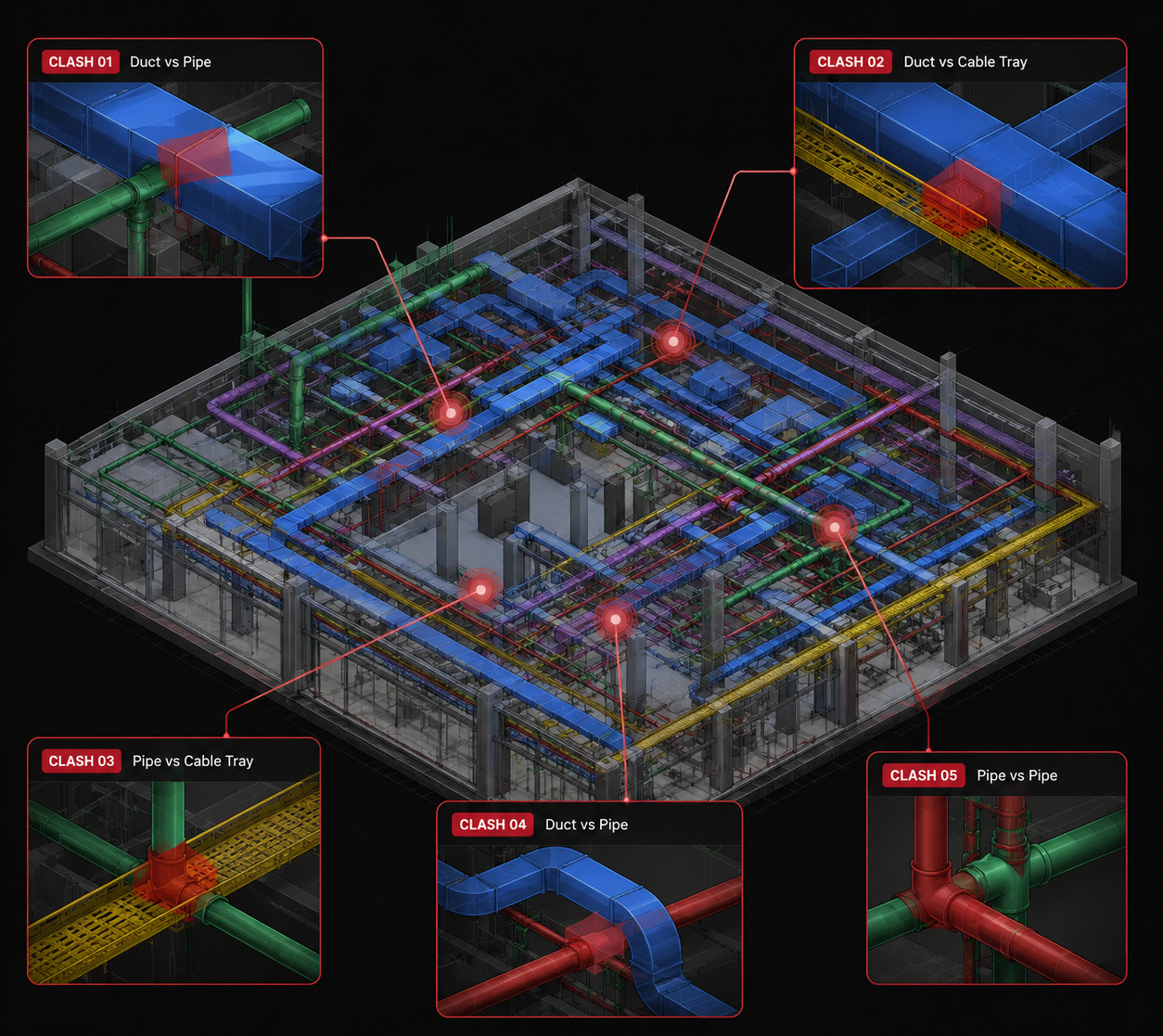
MEP Clash Detection Services Mechanical, Electrical, Plumbing Interference Checking
Professional MEP clash detection services identifying interferences between mechanical, electrical, and plumbing systems before construction. Reduce rework, prevent costly errors, and deliver projects on time.
What Is MEP Clash Detection?
MEP clash detection is the process of identifying interferences between mechanical, electrical, and plumbing systems in a building. Using software like Navisworks, we detect clashes between MEP elements and with other building disciplines, allowing resolution before construction begins.
Think of it this way. A building has ductwork, piping, cable trays, and equipment. All these systems need to fit into limited space while working around structural elements and architectural features. Without proper clash detection, interferences are inevitable. And interferences discovered on site mean rework, delays, and cost overruns.
MEP clash detection prevents this. We use Navisworks to bring MEP models together, detect clashes, and provide clear reports for resolution. The result is a clash-free set of systems that can be installed without issues on site.
What MEP clash detection delivers:
- Identification of all clashes: No interferences missed.
- Clear clash reports: Detailed documentation for resolution.
- Prioritized issues: Critical clashes identified and flagged.
- Reduced risk: Issues identified and resolved before construction begins.
"MEP clash detection is not just about finding problems — it is about preventing costly rework on site."
Why MEP Clash Detection Is Critical for Construction Projects
Construction projects are becoming more complex. More MEP systems. Tighter programmes. Less margin for error. Without effective clash detection, the risks of rework, cost overruns, and programme delays increase dramatically.
Reduced Rework and Cost Overruns
Rework is one of the biggest cost drivers in construction. When MEP clashes are discovered on site, the solution often involves costly changes, time-consuming redesign, and subcontractor delays. MEP clash detection identifies interferences before construction begins, reducing rework and cost overruns.

Improved Construction Sequencing
Clash detection is not just about finding interferences — it is also about understanding construction sequencing. Effective clash detection ensures that MEP trades can access their work areas in the right sequence, with sufficient space and time for each activity. This reduces downtime and improves overall construction efficiency.
Enhanced Subcontractor Coordination
Subcontractors need clear, accurate information to plan and execute their work. Clash reports provide the clarity subcontractors need, reducing confusion, RFIs, and on-site conflicts.
Programme Certainty
One of the greatest risks to construction programmes is unforeseen issues. MEP clash detection provides the visibility needed to identify and resolve issues before they impact the programme, giving project teams confidence in delivery dates.
Types of MEP Clashes We Detect
Click below to toggle between Hard, Soft, and Workflow clash parameters and check examples.
Hard Clash Detection
Hard clashes are physical interferences between elements. Examples include:
- • Ductwork passing through a structural beam
- • Piping intersecting with steel framing
- • Electrical conduits conflicting with HVAC systems
Our team uses Navisworks to identify and document every hard clash in your MEP systems. Each clash is logged with a unique identifier, description, and location for easy resolution.
Our MEP Clash Detection Process
We follow a structured process to deliver comprehensive clash detection that supports project delivery.
1. Model Receipt and Validation
We start by receiving models from all project disciplines.
• Architectural models: Building fabric and finishes.
• Structural models: Building structure and framing.
We validate each model for file format, coordinate system alignment, and basic quality before we begin.
2. Model Federation
We bring all validated models together in a single Navisworks environment.
• Level and zone organization: Clear structure for navigation.
• Visibility settings: Discipline-specific views for clash detection.
3. Clash Detection in Navisworks
We run automated clash detection to identify interferences.
• Soft clash detection: Clearance and access issues.
• Workflow clash detection: Sequencing and phasing problems.
We configure clash rules carefully to identify relevant clashes while minimizing false positives.
4. Clash Analysis and Prioritization
Each clash is analyzed and prioritized for resolution.
• Major clashes: Significant coordination required.
• Minor clashes: Low impact, easily resolved.
5. Clash Reporting
We provide clear, comprehensive clash reports.
• Clash descriptions: Clear description of each clash.
• Clash locations: Precise location information for resolution.
• Clash prioritization: Critical, major, and minor categories.
6. Quality Assurance and Client Review
Every clash detection project undergoes formal QA review.
• Clash rule review: Appropriate rules configured for each project.
• Client review: Walkthrough of clash report before final delivery.
MEP Clash Detection Deliverables Checklist
Complete list of all clashes with locations and prioritize levels.
Structured sheet tracking assignments and resolution status.
All disciplines compiled in a unified coordinated file environment.
Visual records of individual interferences for quick referencing.
Official records of design decisions and resolved clashes.
Industries We Serve
Commercial
Office buildings, retail centres, and mixed-use developments. Complex MEP systems requiring thorough clash detection.
Healthcare
Hospitals and clinics with critical MEP systems for infection control and patient safety. Precise clash detection required.
Industrial
Manufacturing facilities, process plants, and warehouses. Dense MEP installations requiring detailed clash detection.
Education
Schools, universities, and research facilities. MEP clash detection for teaching and research spaces.
Residential
Multi-family and mixed-use residential projects. MEP clash detection for complex services.
Data Centres
High-density MEP installations requiring precise clash detection and redundancy planning.
Software & Technology
We work with current software versions and maintain compatibility with your project requirements.
| Software | What We Use It For |
|---|---|
| Autodesk Navisworks Manage | Clash detection and coordination |
| Autodesk Revit | MEP modeling |
| Autodesk BIM 360 / ACC | Cloud collaboration |
| Solibri | Quality assurance and checking |
Why Choose Us?
Experienced MEP clash detection specialists
Our team has extensive experience in clash detection projects across multiple sectors. We understand the challenges of identifying and documenting MEP interferences.
Navisworks specialists
We are Navisworks specialists. Every team member works in the clash detection environment. We do not assign generalists to clash detection projects.
Quality assurance
Every clash detection project follows a formal QA process. Model validation. Clash rule review. Client review.
Fast turnaround
We understand project deadlines. We work efficiently without compromising quality.
Case Studies
Commercial Office Building — London
Project scope: MEP clash detection for a 150,000 sq. ft. office building with complex HVAC, electrical, and plumbing systems.
Deliverables: Clash detection report, resolution log, federated Navisworks model.
Outcome: 128 clashes identified and documented. All resolved before construction. Rework reduced by 85%. Programme saved 6 weeks.
Hospital Expansion — England
Project scope: MEP clash detection for a hospital wing expansion with critical infection control requirements.
Deliverables: Clash detection report, resolution log, coordination meeting minutes.
Outcome: All MEP clashes identified before construction. Infection control routes maintained. Construction completed on schedule.
Data Centre — USA
Project scope: MEP clash detection for a 50,000 sq. ft. data centre with dense services and redundancy requirements.
Deliverables: Clash detection report, resolution log, federated Navisworks model.
Outcome: 93 clashes identified and documented. All resolved before construction. Construction completed 4 weeks ahead of schedule.
Quality Assurance
Quality is critical in MEP clash detection. A missed clash creates problems on site. Our QA process is designed to catch issues before they become problems.
Our QA process:
- Model validation. All models checked before federation. Coordinate system alignment. Basic quality.
- Clash rule review. Clash rules configured appropriately for each project. Identifying relevant clashes while minimizing false positives.
- Clash prioritization. Each clash analyzed and prioritized. Critical clashes flagged immediately.
- Client review. Walkthrough of clash report before final delivery.
ISO 9001 Compliance
Our QA process follows ISO 9001 quality management principles.
Frequently Asked Questions
MEP clash detection is the process of identifying interferences between mechanical, electrical, and plumbing systems in a building. Using software like Navisworks, clashes are detected between MEP elements and with other building disciplines, allowing resolution before construction begins.
Hard clashes are physical interferences between elements (e.g., a duct passing through a beam). Soft clashes are clearance or access issues (e.g., insufficient space for maintenance). Both require resolution but differ in complexity and impact.
MEP clash detection specifically focuses on identifying interferences. MEP coordination is the broader process of ensuring systems work together, which includes clash detection plus space allocation, clearance checking, and construction sequencing.
Navisworks Manage is the industry standard for MEP clash detection. We also use Revit for MEP modeling and BIM 360 for cloud collaboration.
Costs depend on project size, complexity, and deliverables. We provide fixed-price quotes within 24 hours of receiving your project brief.
Timelines vary based on project complexity and scope. Typical clash detection projects range from 1-3 weeks for small projects, and 3-6 weeks for large or complex projects.
A clash detection report is a comprehensive document listing all identified clashes with descriptions, locations, and prioritization. It is used for clash resolution and coordination.
MEP clash detection is essential for complex MEP installations and projects where coordination is critical. We can advise on the appropriate level of clash detection for your project.
Start Your MEP Clash Detection Project Today
MEP clash detection is essential for successful construction projects — identifying interferences before they become costly problems on site.
Our team of MEP clash detection specialists provides comprehensive clash detection services across all building services.
Contact us today for a free consultation and project quote.