
As-Built BIM Modeling Services
LOD 500 Record Models for Facility Management Handover with COBie Data
Get an accurate, data-rich LOD 500 Revit model of your building — verified against laser scan data and delivered with COBie asset information for FM handover, CAFM integration, and asset management.
What Is As-Built BIM Modeling?
As-built BIM modeling is the process of creating a highly detailed LOD 500 Building Information Model that documents the exact as-constructed state of a building. Unlike design-stage BIM models that represent planned construction, as-built BIM models are verified against actual site conditions using laser scan data, site photographs, and marked-up drawings.
The result is a record model that serves as the definitive digital representation of your building — ready for facility management handover, asset tracking, renovation planning, CAFM system integration, and digital twin applications.
Where point cloud to BIM modeling typically delivers LOD 200–400 models for design and coordination, as-built BIM modeling specifically targets LOD 500 — the post-construction record level that captures every building component with verified geometry and embedded asset data.
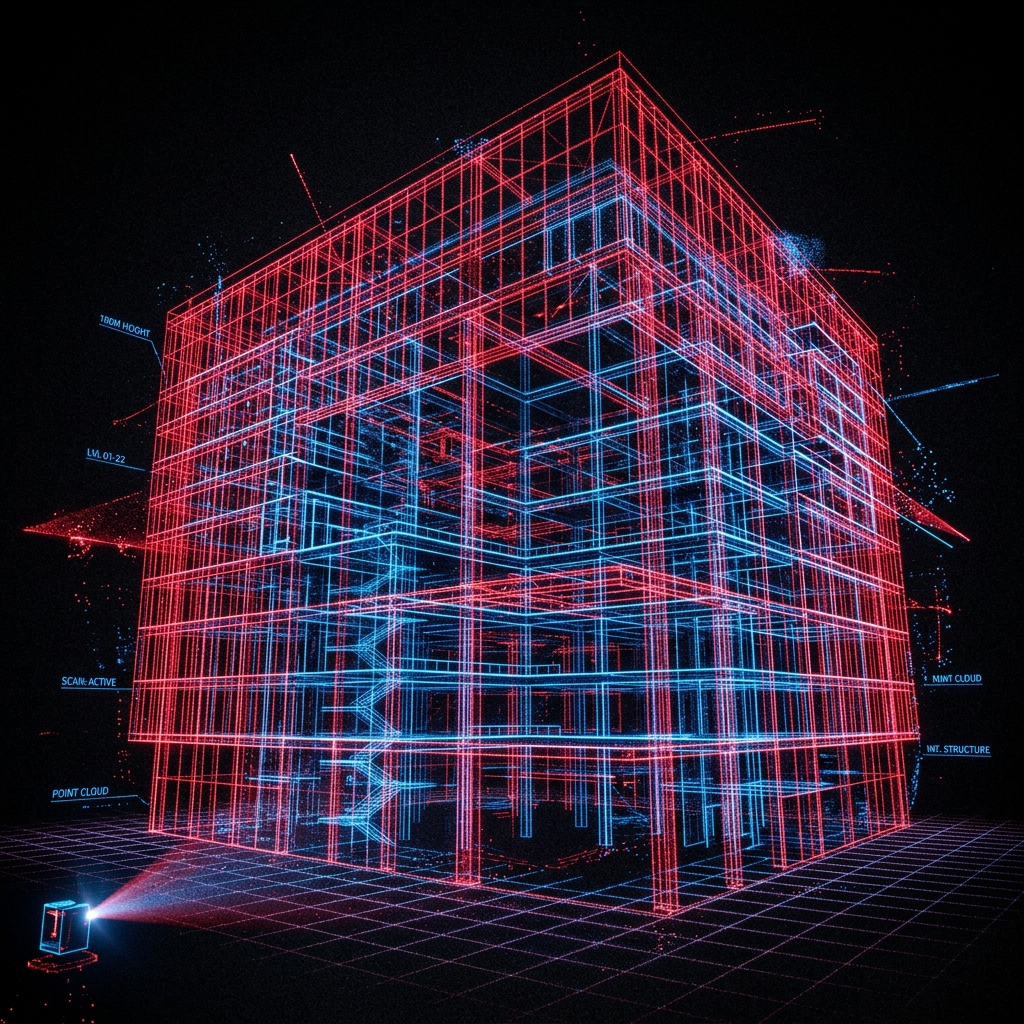
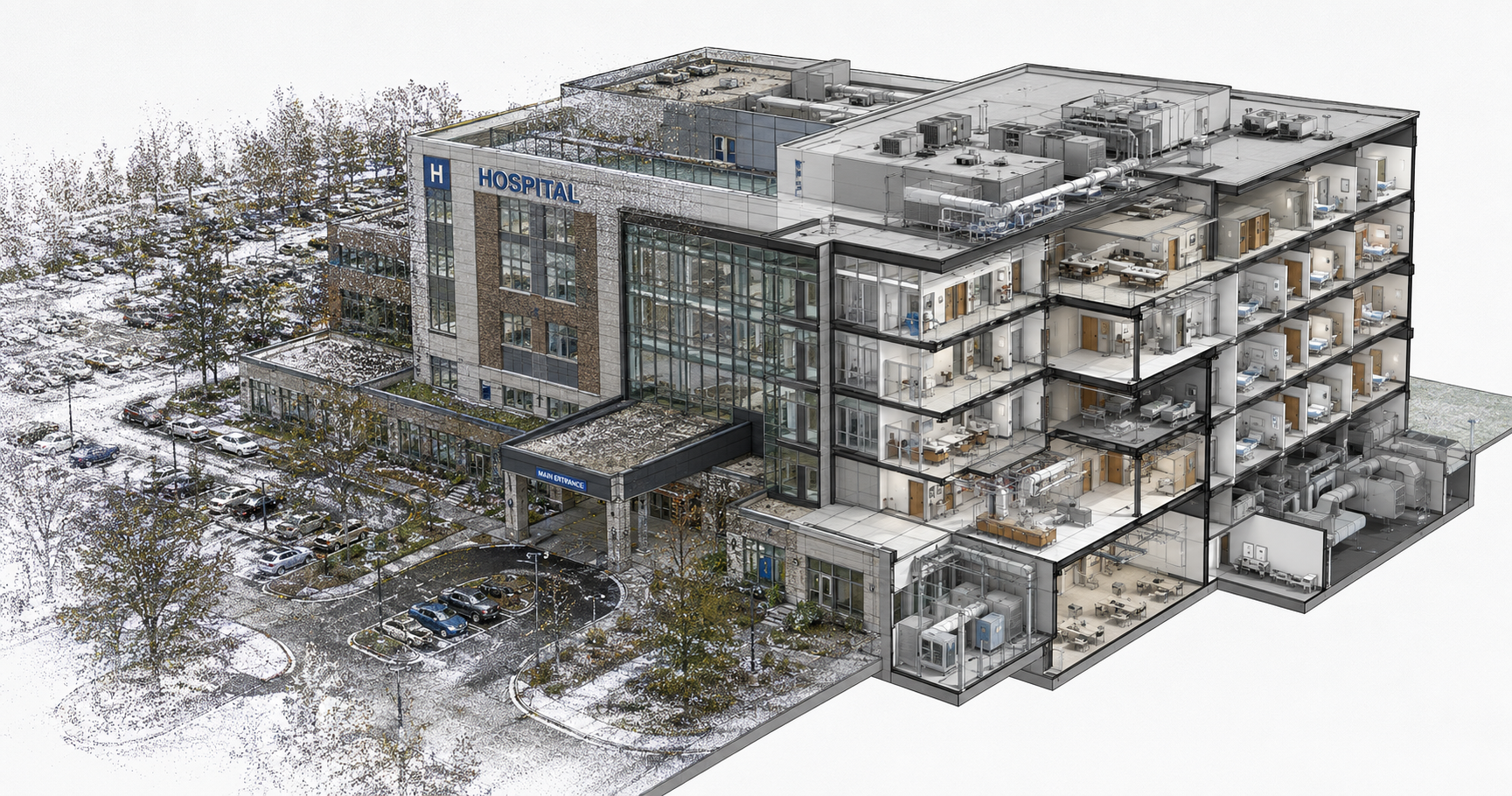
What sets as-built BIM apart:
- Verified accuracy: Every element is checked against scan data or site verification.
- Asset-ready data: COBie information embedded for FM system integration.
- Single source of truth: One definitive record of your building's as-built condition.
- FM handover ready: Delivered in formats compatible with CAFM and CMMS platforms.
"An LOD 500 as-built BIM model is the closest thing to a digital twin of your building — providing facility managers with the data they need to operate and maintain assets efficiently."
Why Choose As-Built BIM Modeling for Facility Management?
Closing the gap between original design documents and the actual on-site layout.
Seamless FM Handover
Consolidate paper documents and plans into a single coordinate-accurate 3D asset file. Receive a complete digital record of components ready for CAFM and CMMS import.
Accurate Asset Documentation
Model elements with precise geometry, specs, and coordinates, allowing facilities teams to plan predictive maintenance, optimize layouts, and track warranties.
Data-Rich COBie Deliverables
Standardized asset attributes are embedded directly, including manufacturer specifications, warranty terms, replacement lists, and performance records, eliminating manual database entries.
Renovation & Retrofit baseline
Establish a highly reliable existing-conditions coordination model, ensuring that design modifications or expansion works match actual on-site dimensions.
Our As-Built BIM Modeling Process
A structured, quality-controlled methodology to deliver LOD 500 records.
Data Collection & Verification
We analyze scan data (E57, RCP, LAS), site photos, and marked-up blueprints to assess coverage and identify details before modeling.
Point Cloud Registration
Import and register scanner coordinates, clean noise, and optimize file parameters inside ReCap Pro or Cyclone.
LOD 500 Model Development
Model all elements in Revit (Architectural, Structural, MEP) with coordinate precision and verified geometry.
COBie Data Integration
Embed comprehensive asset data fields: manufacturer specs, warranties, installation dates, and tags.
Quality Assurance Review
Perform model audits, cross-checks against scans, and validate COBie sheets aligned with ISO 9001 standards.
FM System Handover
Deliver final packages (.RVT, .IFC, .XLSX, .NWC) directly structured for CAFM and estates platform import.
LOD 500 BIM Model Development Specifications
Architectural Modeling
- External walls, internal partitions, & curtain wall panels
- Floor slabs, suspended ceilings, and roof slopes
- Doors, windows, frames with exact family dimensions
- Stairs, ramps, and vertical clearance boundaries
- Room boundaries, areas, and space finishes
Structural Modeling
- Reinforced concrete columns, beams, & flat slabs
- Structural steel frames & connection plates
- Foundation caps, footings, and grade beams
- Core structural shear walls & transfer slabs
- Structural opening frames and deck cuts
MEP Modeling
- HVAC ductwork — supply, return, & exhaust lines
- Pipework — hot/cold water, drainage, fire lines
- Cable trays, conduits, and busbar coordinates
- Mechanical plant, chillers, and air equipment
- Sanitary plumbing layouts and fixtures
Final Delivery Packages & File Formats
| Deliverable | Format | Included |
|---|---|---|
| LOD 500 Revit Model | .RVT | ✓ Yes |
| IFC Export | .IFC | ✓ Yes |
| COBie Data Package | .XLSX | ✓ Yes |
| Navisworks Cache Review | .NWC | ✓ Yes |
| 2D Drawings (Plans, Sections, Elevations) | .DWG, .PDF | On request |
| Asset Database Export | .CSV | On request |
Software & Tech Stack
We utilize standard design and database toolsets to ensure that coordinates are aligned, files are fully interoperable, and asset parameters import perfectly into CAFM environments. We coordinate project versions from Revit 2020 through to current releases to maintain full worktree compliance.
| Software | Role in Workflow |
|---|---|
| Autodesk Revit | Primary BIM modeling environment |
| Autodesk ReCap Pro | Point cloud processing and registration |
| Navisworks Manage | Coordination review and clash detection |
| Autodesk BIM 360 / ACC | Cloud collaboration and coordination |
| COBie Toolkit | COBie data generation and validation |
| Leica Cyclone Register 360 | High-accuracy scan registration |
| CloudCompare | Point cloud QA and analysis |
Industries We Serve
We provide tailored drafting and modeling solutions across diverse construction sectors.

Commercial Real
Estate
High-precision models and coordination for corporate towers and office complexes.

Healthcare
Facilities
Specialized layout plans meeting stringent medical coding and airflow regulations.

Residential
High-Rises
Smart 3D drafting and structural layouts optimized for modern urban living.

Industrial
Plants
Complex piping, equipment layout modeling, and steel structure detailing.

Educational
Institutions
Scalable BIM models for universities, schools, and state-of-the-art campus facilities.

Infrastructure
& Bridges
Heavy civil structural drawings, reinforcement models, and highway layouts.

Hospitality
& Hotels
Interior rendering and shop drawings for premium hotels, resorts, and suites.
Retail
Complexes
Storefront detailing, cladding mockups, and MEP plans for multi-brand retail outlets.
Case Studies
Real-world projects highlighting LOD 500 and COBie integration.
12-Storey Commercial Office Building
Scope: LOD 500 model for FM handover of a 250,000 sq. ft. office tower. Coordinated 15 years of undocumented tenant improvements.
Outcome: Property management teams reduced repair dispatch delays by 35% and boosted asset tracking accuracy to 90% via direct CAFM database imports.
Regional Hospital Facility
Scope: Complete federated model covering 200 beds and complex MEP coordinates for medical equipment asset logs.
Outcome: Achieved strict compliance targets for asset tagging and cut operational maintenance downtime by 25%.
University Campus estates
Scope: Handover models for 8 distinct campus structures, coordinated with open-BIM CAFM integrations.
Outcome: Campus operations saved 60% in manual asset audit overhead and boosted facility space utilization by 15%.
ISO-Aligned Quality Assurance
Dimensional gaps or tag discrepancies can render record models useless. Our QA process is aligned with ISO 9001 quality management principles.
- Model-to-source verify: Every coordinate and cap is cross-referenced with laser scan positions to ensure sub-millimeter precision.
- Parameter audit: Family names, schedules, and tag parameters are audited to match BEP nomenclature rules.
- COBie validation: Data worksheets are run through syntax and structure validators before delivery.
- Independent checks: A senior BIM coordinator reviews every file package before final client delivery.
Why Choose Us?
Certified BIM Experts
Our specialists operate exclusively inside CAD/BIM environments (Revit, ReCap, Navisworks). We never cross-assign traditional CAD drafters.
NDA Protected Data
We enforce strict access limits, encrypted data handling, and NDAs to protect critical building layouts (ISO 27001 compliance).
Flexible Scopes & Pilot Options
We deliver transparent proposals within 24 hours. For larger estates, we offer a free sample pilot model to verify formatting standards.
Frequently Asked Questions
Find answers to common questions about LOD 500, scan requirements, and formatting.
LOD 500 represents the highest level of development in BIM models. It is a record model that precisely documents the as-constructed geometry and attributes of every building component. LOD 500 models are verified against site conditions and are used for facility management, asset tracking, and building handover. Unlike LOD 200–400 models, LOD 500 models include asset data and are delivered with COBie information for FM system integration.
Point cloud to BIM modeling focuses on converting scan data into a Revit model at LOD 200–400 for design development, coordination, or fabrication. As-built BIM modeling specifically targets LOD 500 — the post-construction record model — and includes COBie asset data for FM handover and CAFM system integration. As-built BIM models are the deliverable required for building handover and ongoing facility management.
COBie (Construction Operations Building Information Exchange) is a standardized format for capturing asset data required for facility management. It includes manufacturer details, warranty information, maintenance schedules, and performance specifications. COBie data is critical for FM system integration and efficient building operations. Many government and institutional clients now require COBie data as part of project handover.
We work with a range of source data depending on your project requirements: Laser scan data (E57, RCP, LAS formats), Site photographs for material and detail reference, Marked-up drawings (PDF, DWG), and Existing CAD files and design models. If your project does not include scan data, we can model from marked-up drawings and site photos, or coordinate with your survey team for additional verification.
Project timelines vary based on building size, complexity, and source data quality. Typical project durations: Small building (up to 2,000m²): 2–3 weeks; Medium building (2,000–10,000m²): 3–5 weeks; Large building (10,000m²+): 5–8 weeks. We provide a project-specific schedule with every quote. For urgent projects, expedited delivery may be available.
Standard deliverables include: Native Revit model (.RVT), IFC export (IFC 2x3 or IFC 4), COBie data (.XLSX), and Navisworks cache file (.NWC). Additional deliverables — including AutoCAD DWG exports, PDF drawing sheets, and asset data exports — are available on request.
Yes. We deliver COBie data in formats compatible with leading CAFM and CMMS platforms. If you are using a specific FM system, please let us know and we can align the COBie data format with your requirements.
Yes. We deliver complete, federated as-built BIM models covering Architectural, Structural, and MEP disciplines within a single coordinated Revit environment. All disciplines are modeled to LOD 500 and verified against source data.
Yes, for projects where scan data is not available. However, the accuracy of a model built from drawings is limited by the accuracy of those drawings. Where drawings are outdated or incomplete, we recommend complementing them with scan data or site verification for the most accurate result. Our team can advise on the most suitable approach for your project.
Yes. Our heritage and historic building BIM service specialises in modeling complex, irregular, and non-standard historic geometry. We work with scan data to capture the unique fabric of listed buildings and conservation properties.
Get Your As-Built BIM Model Today
Estates documentation is crucial for maintenance cycles. Connect with our certified coordinators for a drawing evaluation or scoping call today.