
Heritage & Historic Building BIM HBIM Services for Listed Buildings and Conservation
Specialist Heritage BIM (HBIM) modeling for listed buildings, conservation areas, and heritage assets — capturing irregular geometry and supporting conservation compliance and asset management.
.3kq98fdhypygg.png)
.0kpn80qxv4_66.png)
What Is Heritage BIM (HBIM)?
Heritage Building Information Modeling (HBIM) is a specialist application of Building Information Modeling for the documentation, conservation, and management of historic buildings and heritage assets . Unlike standard BIM — which works with standardized, predictable geometry for new construction — HBIM addresses the unique challenges of heritage buildings: irregular, non-standard architectural elements, complex historic fabric, and conservation compliance requirements .
The HBIM process starts with laser scanning the heritage building to capture its intricate geometry in millimetre-accurate detail. This data is then processed and modeled in Revit using custom families that reflect the unique architectural elements of the historic structure. The result is a data-rich HBIM model that serves as the definitive digital record of the heritage asset — ready for conservation documentation, planning authority submissions, heritage asset management, and digital twin applications .
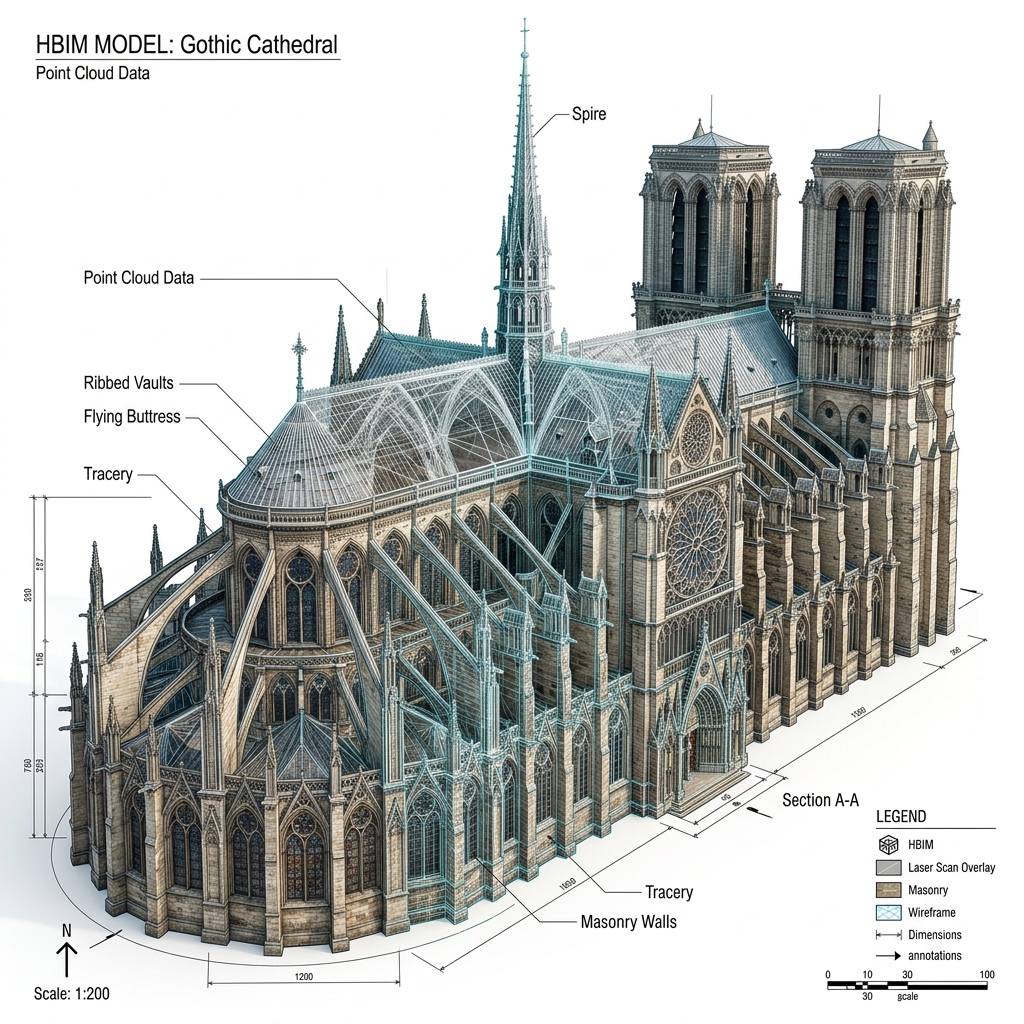
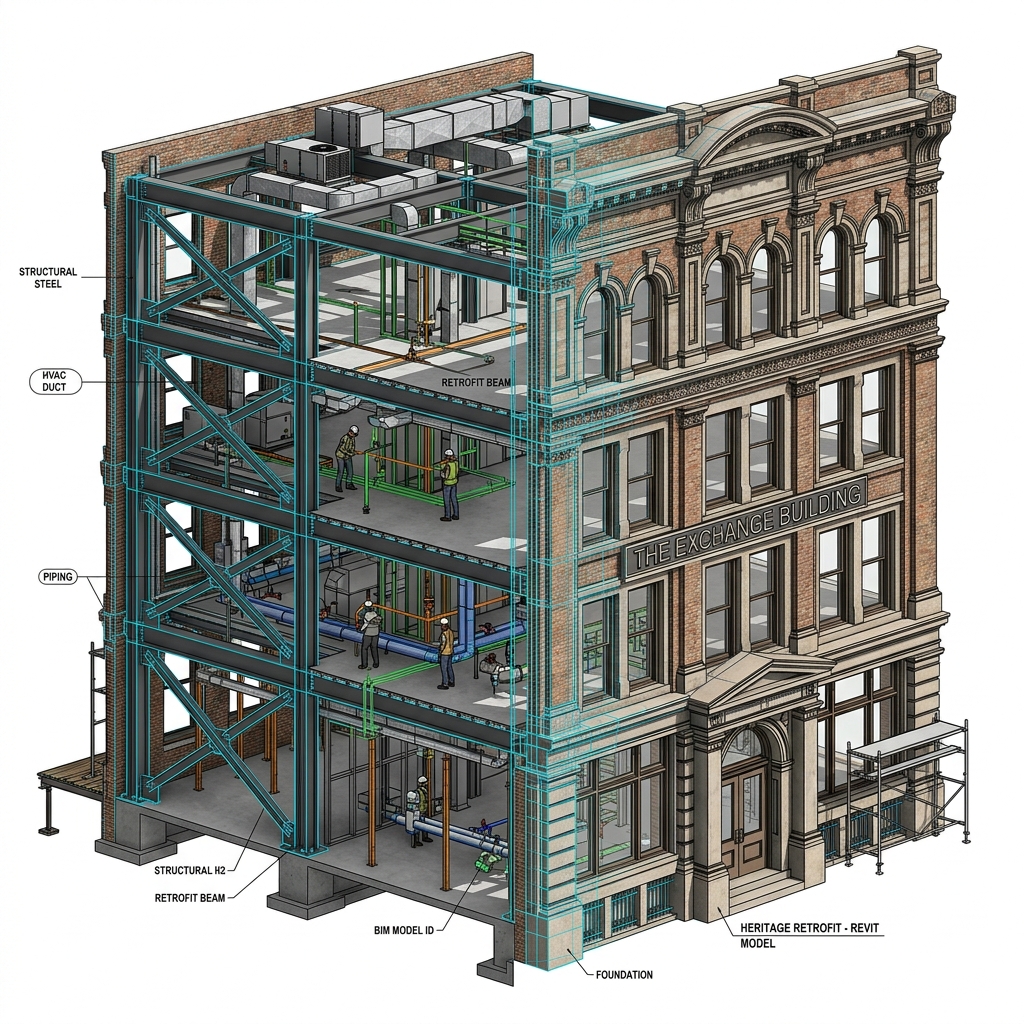
What sets HBIM apart from standard BIM:
- Irregular geometry modeling: Custom families for non-standard architectural elements
- Conservation compliance: Documentation aligned with heritage regulations
- Heritage asset management: Data for long-term conservation planning
- Digital twin foundation: Enabling preventive conservation
"HBIM is beyond just the 3D visuals or Revit model — it is how you operate the project, exchanging information easily between all parties so that risks can be effectively managed." — Heritage Conservation Practitioner
Why Heritage Buildings Need Specialist BIM
Heritage buildings present challenges that modern construction projects do not face. The building you are working on may have evolved over centuries. Original drawings may be incomplete or non-existent. Geometry may be irregular and non-standard. Conservation and planning regulations impose strict requirements.
HBIM addresses these challenges by providing a comprehensive, accurate digital representation of the heritage building, combined with the data needed for conservation compliance and asset management .
Irregular Geometry and Non-Standard Fabric
Heritage buildings often feature irregular, non-standard architectural elements that cannot be modeled with standard Revit families . Our team creates custom families that accurately capture the unique geometry of historic fabric — from ornate mouldings and decorative ceilings to irregular stone walls and timber framing.
Conservation and Regulatory Compliance
Heritage buildings are subject to strict conservation and planning regulations. Our HBIM models support:
- Listed building compliance: Documentation aligned with heritage regulations
- Planning authority submissions: Accurate records for approval processes
- Conservation area requirements: Compliance with local heritage policies
- UNESCO World Heritage standards: Documentation for international heritage sites
Heritage Asset Management
HBIM models provide the foundation for long-term heritage asset management:
- Maintenance planning: Accurate records for scheduled conservation
- Condition monitoring: Baseline documentation for change tracking
- Funding applications: Evidence-based heritage project proposals
- Stakeholder communication: Visual documentation for heritage bodies
Planning Authority Submissions
Planning authorities require accurate documentation for listed building consent and conservation area approvals. Our HBIM models provide the detailed records needed for successful submissions — from heritage impact assessments to conservation management plans.
Our HBIM Process for Heritage Buildings
We follow a structured process to deliver HBIM models that meet heritage conservation standards and client requirements.
Heritage Data Collection and Survey
The process begins with capturing the heritage building in accurate detail. We work with: • Laser scan data: E57, RCP, LAS formats from Leica, FARO, Trimble scanners • Photogrammetry: High-resolution imagery for radiometric information • Site photography: Images capturing materials, details, and site conditions • Historic documentation: Archives, surveys, and historical records If your project does not include scan data, we can arrange the survey or work from your existing documentation. Our team reviews all source data and flags any gaps that may affect the model.
Point Cloud Processing and Registration
The scan data is processed using Autodesk ReCap Pro or specialist heritage software: • Registration of individual scan positions into a unified dataset • Noise removal and cleaning of scanner artefacts • Data optimization for efficient Revit referencing • Quality assessment of coverage and density
Irregular Geometry Modeling with Custom Families
Unlike standard BIM, heritage modeling requires custom families to capture non-standard geometry . Our team: • Creates custom Revit families for unique heritage elements • Models irregular stone walls, timber framing, and ornate details • Develops parametric objects from physical analysis of the building • Ensures geometric accuracy against the point cloud
Heritage Asset Documentation
The HBIM model is enriched with heritage asset data: • Materials and construction techniques: Traditional building methods • Historical significance: Heritage grading and listing details • Conservation status: Condition assessment and heritage risk • Maintenance history: Past interventions and conservation works
Quality Assurance and Conservation Review
Every HBIM model undergoes formal QA review: • Model-to-source verification: Elements checked against scan data • Heritage compliance review: Alignment with conservation requirements • Family and parameter audit: All families verified against project standards • Client review: Walkthrough for heritage stakeholder feedback
Deliverables and Client Review
Final deliverables are issued via secure file transfer: • HBIM Revit Model (.RVT) • IFC Export (.IFC) • Heritage Asset Data (.XLSX) • Navisworks Cache (.NWC) • 2D Drawings (.DWG, .PDF) on request • Conservation Documentation (.PDF) on request
Heritage BIM Deliverables
| Deliverable | Format | Included |
|---|---|---|
| HBIM Revit Model | .RVT | ✓ Yes |
| IFC Export | .IFC | ✓ Yes |
| Heritage Asset Data | .XLSX | ✓ Yes |
| Navisworks Cache | .NWC | ✓ Yes |
| 2D Drawings | .DWG, .PDF | On request |
| Conservation Documentation | .PDF | On request |
Heritage Building Types We Support
Listed Buildings
Grade I, Grade II*, and Grade II listed buildings across the UK, and equivalent heritage grades internationally. Our HBIM models support listed building consent applications and conservation compliance.
Conservation Areas
Buildings within conservation areas requiring sensitive documentation and planning authority submissions. We work with local heritage officers to ensure compliance with conservation area policies.
UNESCO World Heritage Sites
Heritage sites of international significance requiring documentation aligned with UNESCO standards. Our HBIM models support World Heritage site management and conservation planning .
Historic Monuments
Scheduled monuments and historic structures requiring specialist documentation for conservation and maintenance planning.
Religious Heritage
Churches, cathedrals, and places of worship with complex architectural heritage and conservation requirements.
Industrial Heritage
Historic mills, factories, and industrial buildings requiring documentation for heritage asset management and adaptive reuse planning.
Heritage BIM Software & Technology
| Software | Role in Workflow |
|---|---|
| Autodesk Revit | Primary HBIM modeling environment |
| Autodesk ReCap Pro | Point cloud processing and registration |
| Navisworks Manage | Coordination and review |
| Leica Cyclone Register 360 | High-accuracy scan registration |
| CloudCompare | Point cloud QA and analysis |
| Autodesk BIM 360 / ACC | Cloud collaboration |
Why Choose Us for Heritage BIM Services?
HBIM Specialists
Our entire team works within the BIM environment — Revit, ReCap, Navisworks. We understand the unique requirements of heritage projects and the importance of conservation compliance .
Irregular Geometry Experts
We specialise in modeling complex, non-standard heritage geometry. Our team creates custom Revit families that accurately capture the unique architectural elements of historic buildings .
Conservation Compliance Knowledge
We understand the heritage planning and conservation framework. Our HBIM models are designed to support listed building consent applications and planning authority submissions.
Quality Assurance
Every model undergoes formal QA review before delivery. Our process includes:
- Model-to-source verification: Elements checked against scan data
- Heritage compliance review: Alignment with conservation requirements
- Client review: Walkthrough before final delivery
Case Studies
Grade I Listed Church — England
Project scope: HBIM model for a 12th-century Grade I listed church requiring conservation documentation and maintenance planning.
Deliverables: Complete HBIM model with custom families for historic architectural elements, conservation documentation.
Outcome: Conservation maintenance plan developed. Planning authority approval secured.
UNESCO World Heritage Site — Historic Jeddah
Project scope: HBIM model for Al Radwan House, a UNESCO World Heritage site in historic Jeddah, Saudi Arabia, requiring documentation of complex heritage fabric .
Deliverables: HBIM model with custom families for Saudi Hijazi architectural elements, using deep learning for façade degradation analysis.
Outcome: Heritage documentation delivered for conservation planning and monitoring.
Conservation Area — London
Project scope: HBIM model for a 19th-century building within a London conservation area, requiring documentation for change of use planning submission.
Deliverables: HBIM model with heritage asset data, conservation documentation.
Outcome: Planning authority approval secured. Heritage asset management enabled.
Quality Assurance
Accuracy is critical in heritage BIM. A model that does not faithfully represent the heritage building creates conservation risk and compliance issues.
Our QA process ensures every model meets heritage project requirements:
- Model-to-source verification: Elements checked against scan data for dimensional accuracy and correct positioning.
- Heritage compliance review: Models reviewed against conservation requirements and planning standards.
- Family and parameter audit: All families verified against project requirements. Custom families documented for future reference.
- Client review: We provide a walkthrough of the model for your review and feedback.
ISO 9001 Compliance
Our QA process is aligned with ISO 9001 quality management principles.
Frequently Asked Questions — Heritage BIM
Heritage BIM (HBIM) is a specialist application of Building Information Modeling for the documentation, conservation, and management of historic buildings and heritage assets . Unlike standard BIM, HBIM addresses irregular, non-standard geometry and incorporates conservation compliance requirements . HBIM was first introduced in Dublin Institute of Technology and offers a comprehensive platform for documenting, analysing, and conserving architectural heritage using parametric objects created from physical analysis of the building and historic data .
HBIM addresses the specific challenges of heritage buildings: irregular geometry, non-standard architectural elements, and conservation compliance requirements . Standard BIM works with standardized, predictable geometry and is designed for new construction. HBIM requires custom families, specialist survey techniques, and conservation knowledge.
Yes. HBIM is ideal for listed buildings requiring conservation documentation, maintenance planning, and planning authority submissions. The models support listed building consent applications and compliance with heritage regulations .
HBIM projects typically use Autodesk Revit with custom families, Autodesk ReCap Pro for point cloud processing, and Navisworks Manage for coordination. Additional specialist software may be used for heritage survey and documentation .
Challenges include high costs of software and training, lack of expertise in heritage BIM, resistance to new technologies among heritage professionals, and difficulty modeling irregular, non-standard geometry . Our team addresses these challenges through specialist expertise and custom modeling approaches.
Costs depend on building size, complexity, LOD requirements, and deliverables. We provide fixed-price quotes within 24 hours of receiving your project brief.
Project timelines vary based on building size, complexity, and source data quality. Typical durations range from 3-8 weeks for small to medium heritage buildings, and 6-12 weeks for large or complex projects. We provide a project-specific schedule with every quote.
Start Your Heritage BIM Project Today
Accurate heritage documentation is essential for conservation compliance and effective asset management. Our HBIM models provide the detailed, compliant records your heritage project needs.
For large or complex projects, we offer a free pilot model on a sample area before project commitment — so you can verify model quality and accuracy before placing the full order.
Contact us today for a free consultation and project quote.